
As other members of the government have pointed out -- Rural Development Minister Jairam Ramesh and Chief Economic Advisor Kaushik Basu among them -- India cannot afford to delay increasing prices, given the ballooning subsidy bill.
Oil pricing freedom as an idea can succeed only if the ownership of the key oil refiners (read the public sector oil companies) ceases to be government-dominated.
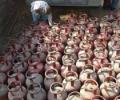
The three govt-owned OMCs - IndianOil, BPCL and HPCL - together meet the country's entire LPG cylinder demand.

Empowered group of ministers on fuel pricing was likely to meet soon.
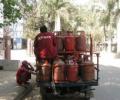
Prime minister's office wants OMCs to bear credit subsidy for remaining 8 subsidised units on reimbursement basis.
The government has slashed allocation of natural gas used for LPG production, and diverted the low-priced fuel to city gas retailers like Indraprastha Gas Ltd and Adani-Total Gas Ltd to meet a part of their requirement for CNG/piped cooking gas supplies, according an official order. The government had in October and November last year cut supplies of low-priced natural gas coming from old fields such as Mumbai High and Bassein fields in the Bay of Bengal, to city gas retailers by as much as 40 per cent in view of limited output.
The government on Friday said it would not increase the cooking gas and kerosene prices despite escalation in the prices globally.
It also demanded increasing the number of liquefied petroleum gas cylinders per family to 12, instead of nine as decided by the government on Thursday.
Indian Oil raised prices of commercial LPG, sold in 19 kg cylinders, to Rs 1,108.5 per cylinder on Nov 1, from Rs 1,095.24 per cylinder on Oct 1. Commercial LPG is not subsidised and oil companies revise their prices in line with international prices on the first of every month. "Commercial LPG prices are expected to go up in December too," said an IO official. But prices of automobile LPG have come down by around 5.34 per cent on Nov 1 compared with prices on Oct 1.
Minutes after the Union Cabinet approved raising the cap on subsidised liquefied petroleum gas (LPG) cylinders from nine to 12 per connection in a year, Reserve Bank of India (RBI) Governor Raghuram Rajan questioned the decision, suggesting it was "misdirected subsidy".
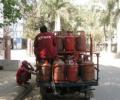
Congress president and United Progressive Alliance Chairperson Sonia Gandhi has directed all party-ruled states to subsidise three additional cylinders a year for domestic liquefied petroleum gas, raising the cap on subsidised cylinders from six to nine.
According to sources, the task force made a separate presentation on fertiliser, LPG and kerosene, covering issues like existing subsidy regime and the proposed new model.
It could become a giant leap towards lasting reform if the experiment in direct benefit transfers for cooking gas subsidies pans out.
The Tihar jail authorities expect the network, which will carry gas to jail kitchens, to be laid out by April and this will cost about Rs 60 lakh, Director General (Prisons) B K Gupta told reporters. "LPG cylinders are widely used by prisoners during riots in jails and we want to avoid such incidents," he said. During the January 7 jail riots in a Jalandhar prison, the inmates threw LPG cylinders into the fire but luckily, these did not explode.
Finance Minister urged to work on alternative modes to lower inflation and help families save more

The ministerial panel is now likely to meet on June 24 or 25.
As the state police declined the provincial administration's directive to allow police stations to be used as distribution points for the supply of liquefied petroleum gas cylinders to the consumers, the crisis has only deepened.
An empowered group of ministers headed by Defence Minister A K Antony is to consider an Oil Ministry proposal of abolishing the priority ranking later in the day, according to which natural gas is first given to urea manufacturing fertiliser plants, then to LPG units, followed by power plants, city gas, steel and refineries.
In the first price revision after the government capped the number of subsidised cylinders for consumers, domestic liquefied petroleum gas (LPG) has become nearly 17 per cent dearer, thanks to firm international prices.

The demonstration was staged at the Alka Talkies Square in the city where the women lit the earthen stove fire using wood and kerosene and offered the tea without milk to the bystanders, even as party workers raised anti-government slogans denouncing the fuel price hike.
The government is working on a plan to pass on part of the revenue loss public sector oil marketing firms are incurring on sale of liquefied petroleum gas and kerosene, to refiners, including Reliance Industries Ltd.
It will soon be two years since petrol was decontrolled, but few will happily celebrate this second birthday.
The explosion, which was caused by a liquefied petroleum gas leak shattered windows in nearby buildings, blew away a bus stop sign and destroyed several cars parked in the neighbourhood, according to a fireman at the scene, state-run Xinhua news agency reported.
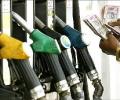
"The Opposition should introspect before resorting to such political opportunism. They raised prices of petrol 21 times, that of diesel 24 times and that of liquefied petroleum gas five times when the National Democratic Alliance was in power," party spokesman Manish Tewari said.

The decision was taken at a full commission meeting held on Thursday under the chairmanship of Chief Election Commissioner V S Sampath, and communicated to the Union Cabinet, which met to take a call on the matter.
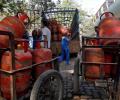
The scheme will cost the state exchequer altogether Rs 1,650 crore.
From online frauds to LPG cylinder accidents, manufacturers and service providers give a host of covers.
Reliance Industries is seeking about Rs 400 crore (Rs 4 billion) from state-owned oil retailers in unrealised amount on liquefied petroleum gas and kerosene, it sells to them.
